
Superman. Super-duper. Supercalifragilisticexpialidocious.
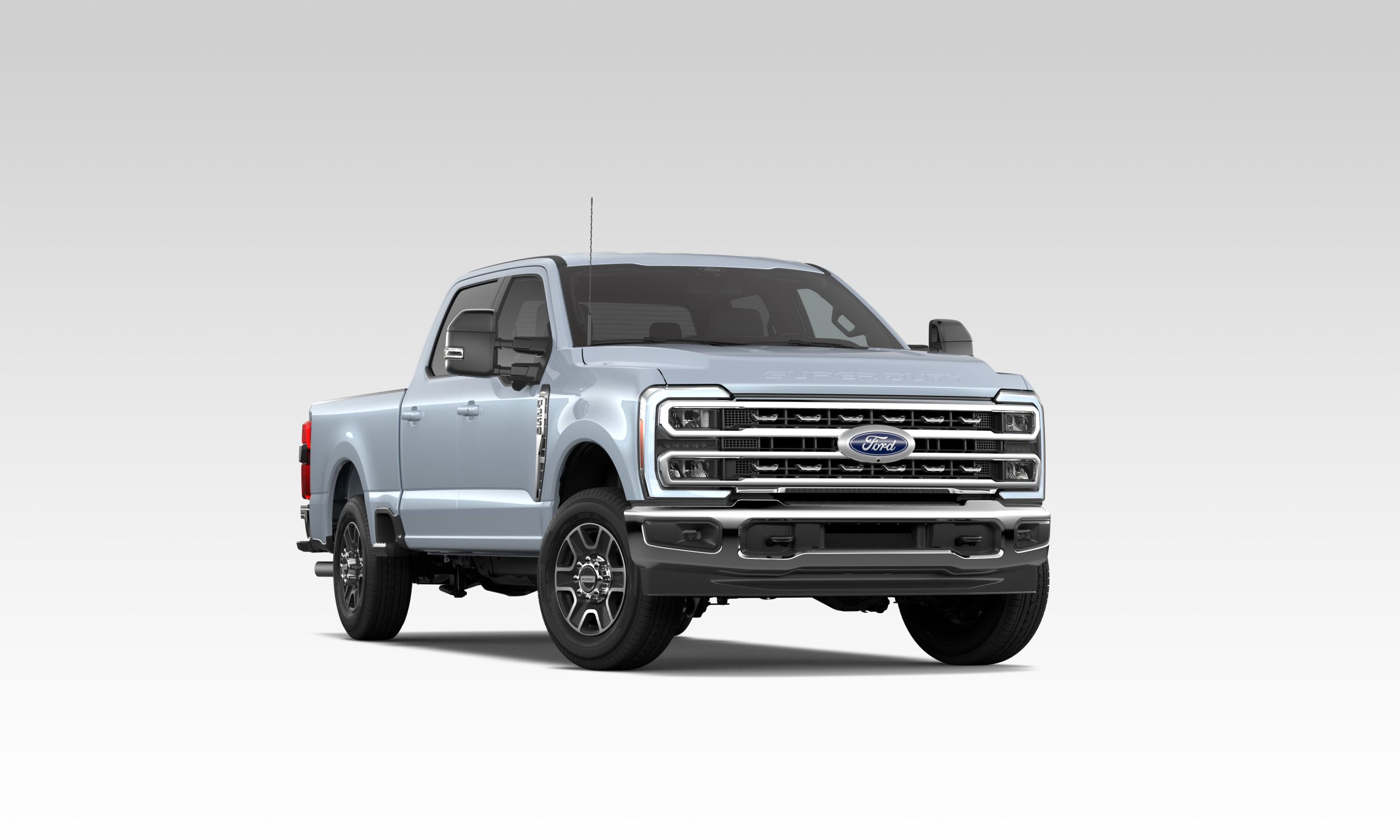
Super is one of those words that’s quintessentially American, and Ford Motor Company puts it to proper use in the nomenclature of possibly the quintessential American vehicle: the pickup truck, specifically across its Super Duty lineup. If you’ve been shopping trucks, you’ve probably seen the names F-150, F-250, and Super Duty used almost interchangeably, and it’s easy to walk away without a clear sense of what separates them: In plain-English, a Ford F-250 Super Duty is Ford’s three-quarter-ton, heavy-duty pickup truck, the entry point in the Super Duty Lineup, which sits just above the light-duty F-150 range.
More About the Ford F-250
A Ford F-250 is a 2500-class truck, built to tow and haul more than a half-ton truck like the F-150. Where the F-150 is engineered as a do-it-all daily driver, the F-250 is engineered first for capability: heavier frame, stronger axles, and engines sized for serious tow-weight.
The “250” comes from Ford’s F-Series naming convention, which signals payload class rather than trim or horsepower. The F-150 is Ford’s half-ton (1500-class) truck. The F-250 is the three-quarter-ton (2500-class) step up. The F-350 continues into one-ton (3500-class) territory. The numbers climb with capability, not just size.
What Super Duty Means
Super Duty isn’t a single model. It’s Ford’s name for the heavy-duty truck family that starts where the F-150 stops: F-250, F-350, F-450, F-550, and F-600. Every one of these trucks shares the same basic mission, towing and payload beyond what a half-ton can manage and scales up in capacity as the numbers climb.
The Ford F-250 Super Duty is where the Super Duty family begins, and it’s the volume leader for buyers who need more than a half-ton without stepping up to the dual rear wheels or higher GVWR of an F-350 or F-450.
F-150 vs F-250: Key Differences
This is where the F-150 vs F-250 matchup gets serious traction. A few areas separate the two trucks well beyond the badge on the tailgate.
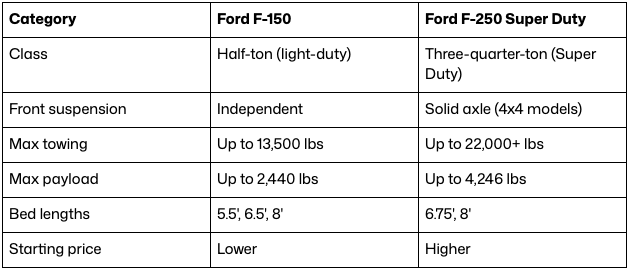
- Frame and suspension: The F-150 rides on a fully boxed steel frame with independent front suspension, tuned for a comfortable daily ride. The Ford F-250 Super Duty uses a solid front axle on 4×4 models and a heavier frame built to carry more weight without flexing.
- Towing and payload: F-150 towing tops out around 13,500 lbs. F-250 towing starts above that and climbs past 22,000 lbs with the diesel engine and the right hitch setup. Payload follows the same pattern: The F-150 tops out near 2,440 lbs, while the F-250 can carry more than 4,200 lbs.
- Engine options: F-150 buyers choose from V6, V8, and hybrid powertrains built for a blend of power and efficiency. F-250 buyers choose from larger-displacement gas V8s and the Power Stroke diesel, sized for pulling heavy loads rather than saving fuel.
- Ride quality and daily drivability: The F-150’s independent front suspension and lighter weight make it noticeably smoother unladen. The F-250’s stiffer suspension stays composed under a heavy trailer, at some cost to ride comfort when it’s empty.
- Bed and cab configurations: Both trucks offer Regular Cab, SuperCab, and Crew Cab options, but bed lengths differ. The F-150 offers 5.5, 6.5, and 8-foot beds. The F-250 offers 6.75 and 8-foot beds.
- Price: The F-150/F-250 price gap is real, and it shows up before you add a single option. F-250 pricing starts higher and reflects its heavier-duty components.
Super Duty Engine Options
Every engine in the Super Duty lineup is built around a single mission: move heavy weight without strain.
- 6.8L V8 (standard gas): The base engine on the F-250, well suited to daily driving, moderate towing, and buyers who don’t need maximum capability.
- 7.3L V8, nicknamed “Godzilla” (available gas): The largest-displacement gas engine in a modern pickup, built for buyers who want big power and strong payload numbers without diesel maintenance and cost.
- Power Stroke turbo diesel: Available in standard- and high-output iterations, the 6.7L Power Stroke delivers the torque that makes the F-250’s highest towing ratings possible. This is the engine pick for frequent, heavy towing.
Who Needs an F-250?
A Ford F-250 Super Duty makes sense when the job calls for it:
- Frequent or heavy towing, especially loads that push past what an F-150 is rated for.
- Fifth-wheel and gooseneck trailers, which need the F-250’s frame and hitch capacity.
- Hauling heavy payloads regularly, not just occasionally tossing gear in the truck bed.
- Commercial and work-truck use, where uptime and duty cycle matter more than fuel economy.
Plenty of drivers are well served by an F-150. If your towing is occasional, your loads are moderate, and daily comfort matters more than maximum lugging capacity, the F-150 will do the job for less money to buy, insure, and fuel. An F-250 is the right truck for a specific kind of workload, but it’s not a truck everyone needs.
Finding or Ordering a Super Duty at The Frederick Motor Co
If you’re browsing trucks for sale in Frederick, MD and a Super Duty is on your list, know going in that many F-250 configurations are built to order rather than sitting on a lot. Diesel engines, specific bed and cab combinations, and work-ready upfits often mean placing a factory order instead of picking one off the row.
And that’s exactly what our team handles every day. Whether you need a specific Ford F-250 Super Duty configuration, a work-truck build, or Ford Pro commercial support for a fleet, we can walk you through ordering, financing, and timelines. If you’re comparing trucks for sale in Frederick, MD and want to see what’s on the lot today, browse our Super Duty F-250 inventory or check out the F-150 lineup if a half-ton fits your needs better.
Ready to talk specifics? Contact us and we’ll help you find the right truck, whether that’s off our lot or built to your spec.
Connect with us


